
I published Rytm Krakowa. It is a small attempt to look at Krakow through time, not only through points on a map. Where is the city active on Tuesday morning? What changes on Friday night? Which places look busy because there are many venues, and which ones actually peak at a different hour?
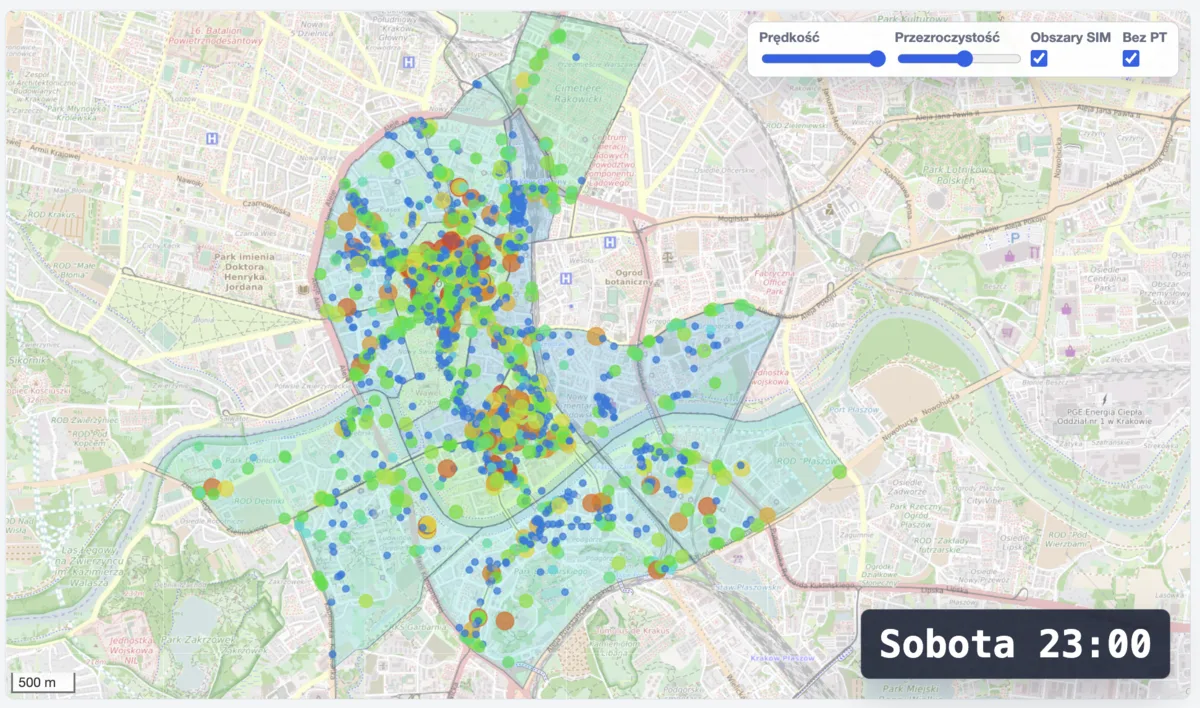
The raw material is not very romantic. I scanned the parts of Krakow where this question is most visible: the old centre, Kazimierz, the belt around it, a piece of Podgorze and Zablocie, plus a few nearby areas that make the comparison less obvious. Google Places API gave me place records inside those boundaries. After that came the usual cleaning work: duplicate places, inconsistent categories, and points that need to be checked against the actual SIM borders.
In the end the scan is large enough to be useful: over thirty thousand places, with a smaller food and night-time layer inside it. Stare Miasto and Kazimierz dominate that layer, of course. But the more interesting part is what happens outside the obvious nightlife map. Shops, public facilities, services, cafes and bars do not move in the same rhythm. Putting them next to each other makes the city feel less like one centre with suburbs and more like several clocks running at once.
The awkward part is that Google Places API does not give Popular Times directly. I had to build a local Chrome extension, open Google Maps pages one by one, and read the rendered opening-hours and popular-hours widgets from the page. It is slow, a bit fragile, and full of edge cases: missing charts, empty shells, consent screens, places with strange categories. The crawler records those statuses instead of pretending that missing data is the same as zero activity.
Popular Times were visible for a little over half of the food and night-time places. That is enough to explore patterns, but not enough to act as if the map is complete. This is why I keep the coverage visible in the project and why the numbers should be read as a signal, not as a census.
There is another catch. A Popular Times value is not a count of people. It is a normalized index inside one place: 100 means the busiest typical hour for that venue, not the same amount of traffic everywhere. Late-night activity can also be cut off by declared opening hours, and Google's categories are not written for urban research. They are useful, but they need suspicion.
So I do not treat Rytm Krakowa as a measuring instrument. It is closer to a sketchbook for questions: where does Friday evening concentrate, when do stores flatten out, which SIM areas wake up early, and which ones only appear in the evening? A table of places and hours hides that. A moving map makes it visible enough to argue with.